Today we printed the famous hinged dissection called the Haberdasher’s Puzzle from Henry Dudeney, who found a way to cut an equilateral triangle into four pieces that reassemble into a square. Dudeney’s solution had an additional property, which is that the pieces could be hinged so as to swing from one form to the other. It’s a beautiful construction and I was recently reminded of it by a tweet from WWMGT (“What Would Martin Gardner Tweet?”). Here are seven copies of the model, laid out so you can see the triangle turn into a square, and vice-versa:
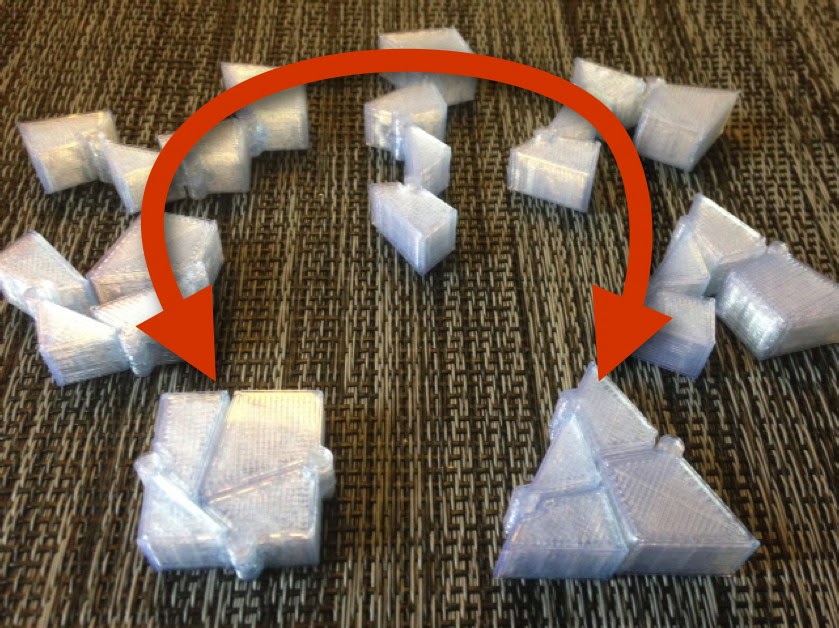
C is at home for a(nother!) snow day with his friend E, who was kind enough to demonstrate how the Triangle-Square works in this short video.
Thingiverse link: http://www.thingiverse.com/thing:263152
Settings: MakerWare .3mm/low on a Replicator 2 with linear infill (just because it looks nicer when using translucent filament), in about 10 minutes, with no raft and no support. The model prints in one piece, hinges and all.
Technical notes: This is the model we were working on in Friday’s post about failing. It was created in OpenSCAD by modifying the code for our Fidget cube from Day 146. When I first started this project, I thought it would be a simple modification. Then I realized I didn’t have coordinates for the dissection of the triangle. After some searching I found an explicit construction with coordinates in coordinates the MapleSoft article Animation of Dudeney’s Dissection Transforming an Equilateral Triangle to a Square by Mark Meyerson of the U.S. Naval Academy. After some trial and error I got this worked into the following coordinates for points A, B, C, E, F, P, Q, R, and S in OpenSCAD code (where s is a scaling factor with default value 35mm):
A1=s*0; A2=s*0;
B1=s*1/2; B2=s*sqrt(3)/2;
C1=s*1; C2=s*0;
E1=(A1+B1)/2; E2=(A2+B2)/2;
F1=(B1+C1)/2; F2=(B2+C2)/2;
P1=(B1+s*sqrt(2*B2/s-(B2/s)*(B2/s)))/2; P2=0;
Q1=P1-s*1/2; Q2=P2-0;
R1=P1+(((F1-P1)*(E1-P1)+(F2-P2)*(E2-P2))/((E1-P1)*(E1-P1)+(E2-P2)*(E2-P2)))*(E1-P1);
R2=P2+(((F1-P1)*(E1-P1)+(F2-P2)*(E2-P2))/((E1-P1)*(E1-P1)+(E2-P2)*(E2-P2)))*(E2-P2);
S1=E1-R1+P1; S2=E2-R2+P2;
The second major problem was that the hinges needed to be angled and oriented to fit on non-square pieces, and also that some of the hinges needed to attach to angles that were much less than 90 degrees. These acute-angle hinges were unstable and didn’t snap apart correctly after printing, so I had to add some stabilizing connectors and then some holes in opposite pieces to accommodate those connectors so the pieces could still fold flush to each other. What I hoped would be easily generalizable code that would work for any hinged dissection with given vertices and hinge locations quickly turned into a mess of one-use angles and hacks to make things close up correctly. But in the end we worked it all out, if messily. Perhaps in the future we’ll make a more generalized OpenSCAD code for these constructions, but for today we are content just to be able to turn a triangle into a square and back again. And again, and again, and again.
UPDATE: This model got a shout-out in the post Using Manipulatives for a fun twist on Dan Meyer’s geometry problem on the mikesmathpage blog. Nice ideas for how to use the Haberdasher triangle-square to get kids thinking openly about mathematics!